


If your LinkedIn strategy relies solely on your company page, you’re already losing your audience’s trust. Consumers’ trust in brands is declining. According to a PwC survey, 90% of business executives think customers highly trust their company, but only 30% of consumers actually do. This is where employee advocacy comes in useful.
A recent 2025 roundup of advocacy stats reports that 92% of B2B buyers trust employee recommendations over traditional advertising. This clearly demonstrates the need for employee voices to be heard.
The go-to place for most B2B brands to ampify their employees’ voices is on LinkedIn. This is a social media platform with a strong professional context. And the fact that the algorithm favours personal profiles over company pages is a bonus!
What Is Employee Advocacy?
Employee advocacy focuses on empowering employees to share authentic content about the company they work for. Organisations, including B2Bs, can tap into the credibility of their team and utilise their personal networks to increase the brand’s reach.
The type of content an employee shares might be: industry insights, company announcements, event photos, or behind-the-scenes moments. When these kinds of posts are shared by real people, instead of the company itself, it feels more engaging and trustworthy.
However, there’s an important distinction to make – employee advocacy is not influencer marketing. For starters, employees work within the business, whereas influencers are external promoters. Their motivations for participating vary as well. Employee advocates typically participate because they believe in the work and want to share their expertise with their network. Influences are motivated by paid partnerships and sponsored content arrangements. Because of this motivation, audiences can sense a lack of authenticity from influencers. The reason employee advocacy is so powerful is that it’s authentic and motivated by reasons other than personal gain.
The foundation for most B2B brands’ employee advocacy strategy is on LinkedIn. It combines professional intent and an algorithm designed to reward real human conversations in a way that many a lot of the other platforms don’t. For B2B brands, it creates the perfect space for its employees’ voices to be amplified and creates credibility.
The Business Benefits of Employee Advocacy for B2B Brands
This is one of the most common questions we get asked as a B2B marketing agency. There are so many reasons why employee advocacy is valuable to B2B businesses – it enhances trust, increases brand awareness, aids talent attraction and more.
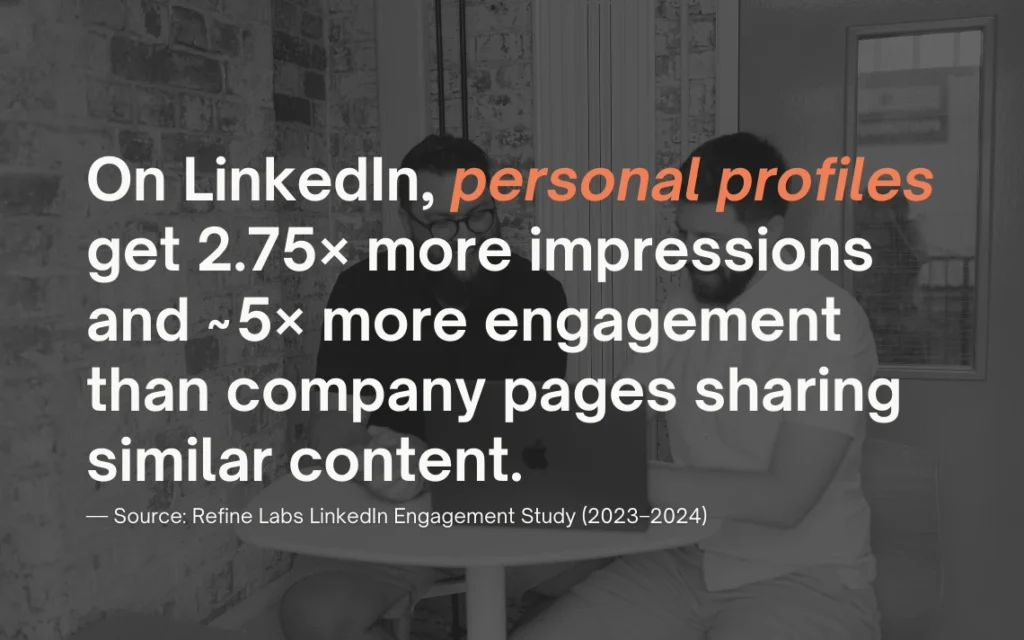
With regard to increased reach and visibility, posts from personal LinkedIn profiles consistently outperform company pages. By using employees to spread a brand’s message, it travels further and reaches new, untapped audiences.
The second main benefit of employee advocacy is that it boosts a company’s credibility. Employees rank among the most believable voices for business in the eyes of a consumer. So the content they share automatically feels more authentic and influential than corporate messaging.
Not only does advocacy attract new customers, but it also attracts new potential employees. When current employees talk openly about their work, achievements and company culture, it creates a more believable picture for potential talent of what it’s like to work for a brand. This results in attracting stronger candidates and reducing hiring costs.
Together, these benefits (along with numerous others) make employee advocacy one of the most effective ways for B2B brands to grow on LinkedIn.
How to Build a Successful Employee Advocacy Programme
So, we know employee advocacy is important, but how do we go about building a strategy for your B2B business? Remember, that you can’t just “switch on” this programme – it needs careful, considered planning to make it worthwhile. Below are the first key steps to take to build an employee advocacy programme for your business.
Define Your Goals
The first step is to define what you want the advocacy to actually do. There’s no right answer here. Define the goals in a way you can measure the success of the programme and use it to leverage results. It could be to increase brand awareness, establish trust, build demand, aid recruitment, or share thought-leadership.
Think about how you envision employee advocacy fitting into your wider business goals and LinkedIn activity. Maybe you’re in a growth phase and need to attract more skilled professionals to your talent pool. Or, perhaps, you’re new to the market and need more people to be aware of who your organisation is and what you do.
Once you’ve pinned down your goal, you need to consider how you’re going to measure the success of this advocacy. Will it be reach, engagement, profile views, conversations or inbound sales? Will the metrics vary when considering long-term vs short-term success? Employee advocacy isn’t a quick win that will solve all your issues; it’s a tool to use as part of the wider marketing strategy. Setting these expectations internally at the beginning will ensure the successful rollout of the programme across the organisation.
Create the Right Conditions
Encouraging employee advocacy is a fine balance between providing tools and support to make it straightforward, whilst not being too prescriptive and limiting employees’ authentic voices. Audiences trust employee voices because they feel real. But if every post starts sounding like all the other employee posts, it will quickly lose its power.
Leadership play a key part in making advocacy feel encouraged. They should be actively participating and buying into what you’re asking of all employees. This isn’t just for the short-term; they should aim to build long-term participation habits. They should also be the initiators of recognition with the team and amplify the voices of employees who are investing in the programme.
Remember – employee advocacy should never be mandatory. It will counteract the message you’re trying to convey by having a team that genuinely believes in the business and wants to shout about the culture, values and products.
Identify Advocates
Once you’ve decided on your goals for your employee advocacy programme and how you’re going to support your team, it’s time to look for who you want to participate.
Advocacy doesn’t need to involve everyone in the whole organisation. Look for people who are already active on LinkedIn and regularly engaging on the platform. Some people will be more suited to different types of posts; you might have employees with certain subject matter expertise, some suited to thought leadership, and others in customer-facing roles who can offer useful customer support and guidance.
There will likely be different levels of participation within your organisation. Some employees will get involved in actually creating posts, but more will likely participate by resharing, commenting and liking content produced by others. All participation is important and valuable. There’s no need to force people into a level of participation they’re not comfortable with.
Make sure to encourage a diversity of voices, roles and perspectives to make sure your organisation is represented accurately and fairly. It also means there’s a range of different voices for an audience to relate to and identify similarities with. You will probably want to start with a small group of employee advocates and expand this group later on when the initial group are set up and comfortable with the programme.
Provide Guidance
Often, people want to help with employee advocacy, but don’t know where to start. Create some rough guidance for the team, including things like content themes to create posts around, to get the ball rolling.
Start by setting up some clear guardrails around what it’s okay to share and what it’s not. For example, it’s good to share personal perspectives on industry trends and challenges, but this shouldn’t include any client data, names or project details without permission.
You also want to establish some guidelines to ensure your employees align with brand messaging, without killing their personal voice. Provide them with examples or prompts rather than scripted posts to ensure authentic voices are heard, not a corporate one. This will make it easy for the team to participate consistently and make this programme a success.
Support Personal Brands
Employees will be more receptive to participating in your employee advocacy programme if they can see the personal value in it, not just company benefits.
Businesses often find that if they provide training and support around developing personal brands on LinkedIn, they get more active participation in their employee advocacy programme.
If you can provide your team with the resources to write in a natural, human way without sounding salesy, and build their confidence to post publicly, you’ll develop more successful, valuable employee advocates.
What Good Employee Advocacy Looks Like
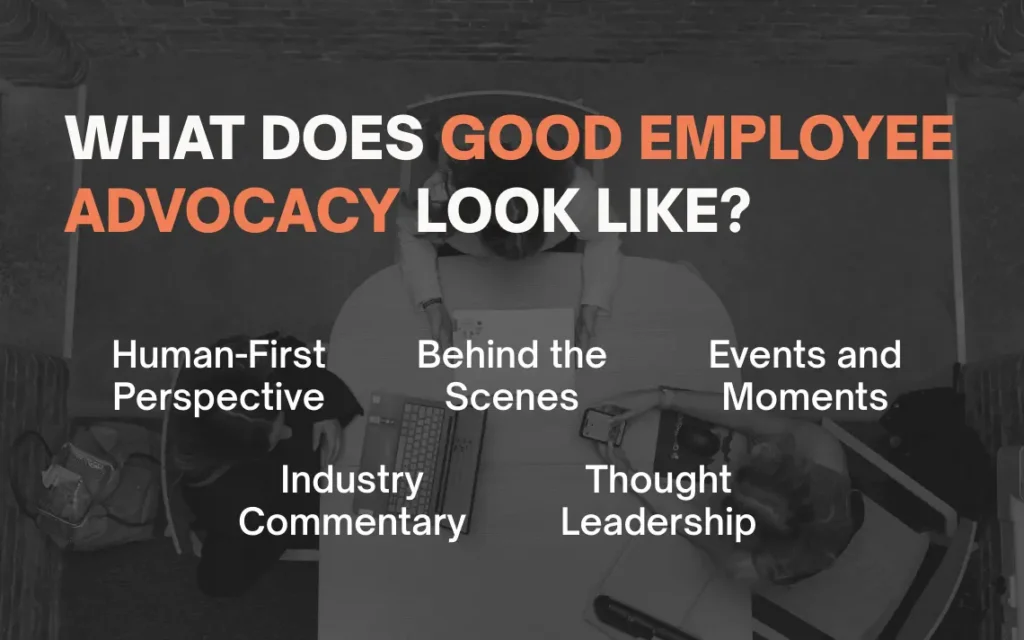
There should be a clear distinction between the content that you are putting out as an organisation and what your employees are posting. One of the main reasons for using employee advocacy is to bring humanity and authentic voices to your brand. The posts should all maintain a natural, conversational tone and start with your team’s real lived experiences. The key is to get your team focusing on adding value and starting conversations, not sticking to the rigid corporate guidelines your company pages need to.
Types of Content
One of the easiest and most successful ways for your team to create employee advocacy posts is to discuss behind-the-scenes insights. Sharing how work actually happens makes B2B feel more tangible. They can use real moments like projects, events and milestones to not only build their personal brands but also bring a human element to the work of your organisation. Encourage them to share these moments in a way that’s still offering value to an audience, moving beyond “we attended” to “here’s what we learned.”
Another type of content your employees might want to centre posts around is industry commentary and thought-leadership. This could be a response to industry trends and news, offering an informed perspective rather than hot takes. It builds credibility and authority over time for the employee and the company. Not every employee needs to do this, but it’s high-impact when done well.
Content types will overlap and evolve as your employee advocacy programme progresses. Your employee confidence will build over time as well, with the increase in engagement with the content and the programme. Advocacy doesn’t need to look the same for everyone; some people will be making posts, others will be commenting, reacting and sharing. All of this engagement in the programme is needed and important!
Bonus: If you’d like some more content ideas to share with your team, click here.
How to Measure Success
There’s little point rolling out an employee advocacy programme if you have no way to measure its success. The tricky part is that it can’t be measured by vanity metrics alone, as these traditional metrics don’t tell the full story in B2B. Measurement should reflect both brand and business impact with a mix of qualitative and quantitative signals to give the clearest picture. It’s vital you set the expectations of what success looks like from the get-go, so that the whole business is aligned on the strategy and desired outcomes.
Engagement
Engagement is likely the metric people think to look at first when measuring success on social media.
Saves and shares should be valued more than likes and views, as they’re signals of relevance. You want to see an increase in these figures across both employee and company posts over time. You should take into account the quality of conversations in comments and the consistency of the messaging across profiles.
It’s also worth noting who is engaging; is it mostly other colleagues that are sharing the content, potential new hires, or current clients? Is the content reaching the people you need it to? If not, perhaps your current strategy is not working despite high engagement figures.
Commercial Influence
Although advocacy’s role is awareness and consideration, not direct conversions, it’s worth looking at its role in the wider picture.
Advocacy should be viewed as an assisted influence, contributing to deals alongside other channels, rather than being credited with the click conversions. Employees can become additional touchpoints in a customer’s journey. Potential customers may follow or engage with individuals long before they ever visit your company website or page.
Early indicators of influence include things like profile views, connection requests, direct messages, replies to comments, or references to posts in conversations. If you’re seeing an increase in these areas, this is a strong signal that your advocacy programme is working.
Recruitment Metrics
Recruitment might not be one of your primary goals for your employee advocacy programme, but if your strategy is working, you will see a positive impact on your metrics when hiring new team members.
The biggest indicator of a healthy company culture is when the employees sing the praises. Everyone wants to work in an environment where they feel supported and engaged. Your current team can be the key to shaping that brand signal and attracting new talent.
If your advocacy programme is working, you will not only see a reduced reliance on paid recruitment channels but a higher quality of candidates. You might also attract more direct messages and emails enquiring about work opportunities outside of your hiring campaigns.
Brand Awareness
Awareness is often the core aim of rolling out an employee advocacy programme. You want more people to know who you are as an organisation, what you do, and to build customer trust.
Over time, successful programmes will see follower growth and more profile views as a result of increased visibility in new, untapped audiences. But remember, awareness is more of an indicator of a successful strategy, as opposed to a metric you can directly measure.
Successful strategies will see your company name get an extended reach via your employees’ posts. The repeated presence of company-affiliated voices in industry conversations builds trust and familiarity.
Conclusion
Employee advocacy programmes are all centred around one main thing: trust. The most successful organisations utilise their employees’ voices by giving them a space to share their thoughts and support to be heard.
By creating the right conditions and letting employees lead with authenticity, B2B brands can build trust in a way company pages simply can’t.