
The LinkedIn Algorithm Decoded: What Actually Gets You Seen in 2026

If your LinkedIn content has been underperforming lately, you’re not imagining it. Sometime in late 2025, posts that should have done well started flatlining, with content creators seeing reductions in reach and engagement dramatically slowing.
What changed wasn’t the quality of the content, but rather the rules of the game. Around this time, LinkedIn’s algorithm went through its most significant overhaul in years, and most B2B marketing teams are still operating on outdated assumptions.
As a social media agency, we spend a lot of time inside LinkedIn’s data for clients, and 2026 has been a genuinely different game. In this guide, we’re going to explore the LinkedIn algorithm in 2026 to see how it functions, which signals matter, what’s killing reach across the board, and how to build a content strategy that works with the new system rather than against it.
How the LinkedIn Algorithm Actually Works Now
Before you can optimise for the algorithm, you need to understand what it’s doing and why.
LinkedIn’s ranking system has moved away from rewarding volume and surface-level engagement and now measures something the platform calls “content depth.”
Content depth may sound like a buzzword, but it’s actually very simple: it determines whether your post genuinely held someone’s attention and sparked real conversation, or if it was just filler content with no real value.
On top of this, the algorithm that judges your content has several different things it’s trying to achieve, and content that helps it achieve those goals will be pushed to larger audiences:
- Keep users engaged: Show content that keeps people on the platform longer.
- Foster meaningful connections: Prioritise content that creates real interactions.
- Maintain quality: Filter out spam, low-quality content, and violations.
- Personalise the experience: Show each user content relevant to their interests and network.
The Three-Stage Distribution Model
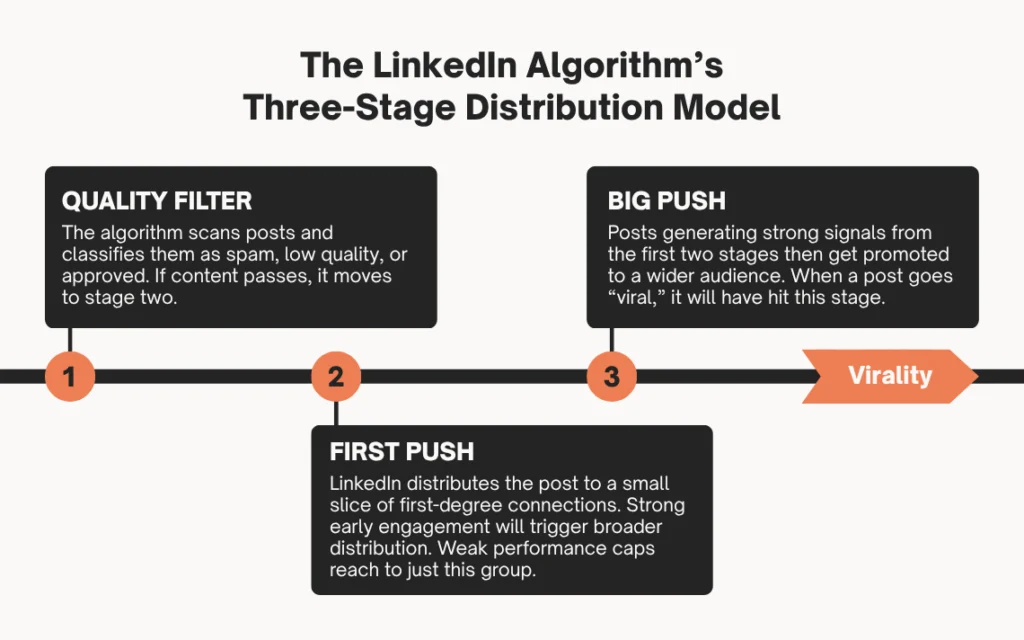
Now, whilst the LinkedIn algorithm – as well as the algorithms on other social networks – is a bit of a black box, there are several things we do know about how it functions. The first of these things is the judgment model it uses when you post something.
When you publish a post, it doesn’t go straight to your full network. Instead, it’s put through a sequential process that determines whether it deserves wider reach (based on the goals we looked at above).
The first stage is the quality filter. The algorithm scans your post immediately and classifies it as spam, low quality, or approved. Posts that look promotional, contain repetitive language, or show other spam-like signals get suppressed before a single person sees them. If your post passes, it moves to stage two.
Stage two is where most content either takes off or dies. LinkedIn distributes the post to a small slice of your first-degree connections, typically around 2–5% of your network, and watches how they respond in the first 30 to 60 minutes. Strong early engagement from this small portion of followers will trigger broader distribution by the algorithm. Weak performance, on the other hand, caps your reach at that initial group.
Stage three involves pushing the content out to a wider audience. Posts generating strong signals from the first two stages are then promoted to a wider audience, people potentially outside of your second- and third-degree connections to people who don’t follow you at all. When a post goes “viral” on LinkedIn, it will have hit stage three.
The important thing to remember is that understanding this sequence is essential for growing on LinkedIn. It should change how you think about everything, from posting times to formats of content and even to what you’re asking your connections to do in the first hour after you post.
The Shift to Interest-Based Distribution
LinkedIn has also moved away from purely network-based distribution (showing content because of who you know) toward interest-based distribution, showing content based on what you engage with. This explains why overall impression numbers have dropped significantly since 2023, while engagement rates per post have increased. Fewer people see each post, but they’re better matched to the content topics.
For b2b marketing teams, this is good news if you post with genuine topical consistency. LinkedIn is building what amounts to a topic profile for every account. Post repeatedly about the same area of expertise and the algorithm starts distributing your content to people interested in that topic, regardless of whether they’re connected to you.
However, if you post inconsistently across unrelated subjects, you’ll confuse the system and your reach will reflect that.
Engagement Signals: What the Algorithm Likes
We’ve spoken about the algorithm checking your content in three distinct stages. The next thing we need to know is what engagement signals it’s looking for.
On LinkedIn, not all engagement is equal. The platform has made increasingly clear – both through official documentation and observable data – that it weights the various engagement signals very differently.
Keep reading to explore how comments, dwell time, as well as post saves and sends all contribute to the algorithm seeing your content as valuable.
Comments Carry the Most Weight
Comments are the strongest signal the algorithm recognises. Estimates on the exact weighting vary, but the directional consensus is consistent: a comment is worth significantly more than a like in terms of algorithmic distribution.
More importantly, comment threads (those back-and-forth conversations rather than one-off replies) trigger aggressive reach expansion. What does this actually mean? Well, in real terms, it means a post with ten substantive comments will reliably outperform a post with a hundred likes.
Why? Because commenting requires both time and intent. You can like a post in under a second, but writing a response takes genuine thought and effort. LinkedIn interprets that effort as a signal that your content is worth people’s attention and thus distributes it accordingly.
This has an important practical implication: how you respond to comments matters. Replying to comments within two hours of posting has been shown to increase overall engagement by around 30%.
So, if you want your content to make it out of the first stage of the LinkedIn algorithm’s distribution model, you need to be replying to every comment on your post, as well as asking follow-up questions that invite further conversation. This extends the algorithmic lifespan of a post well beyond its initial distribution window, because it keeps your audience coming back to the post to reply.
Dwell Time: The Hidden Driver
Dwell time is a metric that’s used in more places than just LinkedIn. It’s used on websites, articles, apps, videos, podcasts, and anywhere a person can spend time consuming content.
This metric shows how long someone spends reading or viewing your content, or how long someone has dwelled on it before leaving, and it’s become one of the most consequential metrics in the LinkedIn algorithm.
Posts where someone reads for thirty seconds or more substantially outperform posts that generate a quick tap-and-scroll reaction in audiences, which is why posts that use clickbait hooks but don’t deliver on them tend to die quickly. The first impression of the post buys a moment of attention, but if the rest doesn’t hold it, that moment gains nothing algorithmically.
Saves and Sends: The Newer Signals
In late 2025, LinkedIn added Saves and Sends to post analytics. That decision was deliberate: LinkedIn was telling the market what it now values. Content that people save to return to later, or send directly to a connection, is being rewarded with additional distribution.
These are the signals of genuinely useful content, the kind that people treat as a resource rather than something to scroll past. If you see your posts getting plenty of saves, it’s a sure sign that the topic you’re writing about is resonating with your audience. For B2B content teams, this points toward specific types of content: practical frameworks, useful data, step-by-step breakdowns, and original insights that someone would want to keep or forward to a connection. Whilst entertaining content gets likes, genuine utility gets saves and sends… and the algorithm notices the difference.
What Gets Distributed in 2026
As we’ve just covered, there are a number of engagement signals that LinkedIn is looking out for. To add to this, not all content is built the same, either.
LinkedIn’s algorithm doesn’t treat all formats equally. If you’re looking to build your personal brand on LinkedIn, or if you’re a B2B brand looking to make the most of the platform, you should aim to include plenty of the below in your content strategies.
Document Carousels (PDFs)
If you’ve ever seen a graphic carousel on LinkedIn, it will have been a document-style post. This is where LinkedIn allows you to upload a PDF, give it a name, and then embed that file directly into your post.
Document posts consistently show the highest average engagement rates of any format on LinkedIn, with analysis of 2026 data putting an average engagement rate for document carousels at around 7%.
The reason is straightforward: every swipe through a carousel slide adds to dwell time, and well-structured carousels naturally generate more of both dwell time and comments. For B2B marketers, breaking down a methodology, data report, or process framework into a 7–10 slide carousel is currently one of the most effective formats available.
Native Video
Native video (meaning video content uploaded directly to LinkedIn rather than linked from YouTube or another platform) continues to perform well. This is the same for all social media platforms.
In video creation, there’s something called the 3-Second Rule, which suggests that if someone isn’t hooked into a video within the first three seconds, they’re going to scroll away. Another good practice is including captions in your video content, because most people have their volume down by default. If you’re wondering why native video performs better than external video, it’s because (like most platforms) LinkedIn doesn’t want users to leave, so penalises posts that include external links.
Text-Only Posts
Text posts remain viable when the writing is strong and the hook is specific. The format performs well for personal perspective pieces, strong takes, and content that’s genuinely worth reading for its own sake.
Low-effort text content (posts with vague observations, empty motivational statements, words that say nothing concrete, etc) fails the engagement test almost immediately and receives no distribution boost.
If you want to know how to build a winning LinkedIn text post, check out our guide here.
What’s Killing Your Reach
Understanding what not to do is just as important as knowing what works. In the last few years, there were several engagement-hacking tactics being employed on social media. However, in recent years, platforms and algorithms have become wise to these methods and actively penalise accounts that use them.
Below you can see a number of tactics and post-styles that no longer perform as effectively as they once did.
Posts with External Links
As we’ve mentioned, LinkedIn wants its users to stay on the platform, and it’s through including external links in their posts that many B2B teams are losing reach without realising it.
Posts containing external links in the body see a dramatically reduced reach than equivalent posts without them – with some experts stating this reduction is as high as 60%. Naturally, LinkedIn’s priority is keeping users on the platform, and any content that tries to redirect attention elsewhere gets penalised for it.
A workaround for this is adding an external link in the comments of a post. Whilst it doesn’t seem like this currently impacts reach, it’s possible that an algorithm update at some point in the future will discourage this behaviour. However, as of June 2026, it still works.
Engagement Bait
Engagement bait is content designed to get people to comment or share a post without providing any useful or salient advice within. These can be posts with phrases like “Comment YES if you agree,” or “Tag someone who needs this.”
Tactics like this are now recognised by LinkedIn’s natural language processing filter as engagement bait and are penalised accordingly. The algorithm has become sophisticated enough to identify the pattern regardless of exact wording, so if your post’s engagement strategy relies on prompting low-effort responses, you could be actively triggering a suppression filter and harming your reach.
Engagement Pods
A common tactic (not just on LinkedIn but every social media platform) is engagement pods. These are groups of accounts that coordinate to like and comment on each other’s content within the first hour of a post being live.
The goal for them is to bypass the first step of the three-stage distribution model we spoke about earlier, with the idea being that posts can be artificially inflated and then pushed further along the lifecycle.
In an interview with Forbes, Oscar Rodriguez, the VP of Trust Product at LinkedIn, made it clear that this tactic of artificially boosting engagement is no longer viable. Whilst he didn’t reveal the exact process the algorithm uses to detect engagement pods, he said it looks for “concentrated activity, the same members at the same times within the same timeframes.”
So, if you’re using pods as part of your strategy, you should be well aware that detected pod activity results in permanent reach reduction.
Posting Inconsistency and Topic Drift
Because LinkedIn now builds a topic profile for each account, posting inconsistently or across too many unrelated subjects actively damages your distribution.
The algorithm identifies your area of expertise based on what you post about consistently and uses that to match your content to relevant audiences, which means that if your last ten posts covered six different topics, the system has no clear read on what you’re authoritative about. When this is the case, it will default to limited distribution.
The Best Times to Post on LinkedIn in 2026

Timing doesn’t determine reach on its own, but it matters for the distribution model we’ve already covered. You need your most engaged followers to be online when you post in order to generate the strong early engagement that triggers broader distribution.
Analysis of large-scale LinkedIn posting data consistently points to Tuesday through Thursday, between 10am and 5pm in your audience’s time zone, as the window with the highest B2B engagement. Sprout Social’s data specifically identifies sustained afternoon activity from 1pm to 5pm on Tuesdays and Thursdays as a strong window for B2B content, reflecting LinkedIn’s role as a late-day professional resource rather than a casual scroll platform.
Early morning posts (around 7am to 8am on weekdays) also perform well for B2B audiences, particularly for text-based content that professionals read during commutes or before the working day begins.
Interestingly, Monday before 10am seems to reliably underperform, which we could surmise is because it’s the first day back to work after the weekend and people are busy catching up and clearing inboxes. We can also see that weekends across the board have lower engagement when compared to the rest of the week, perhaps because people see LinkedIn as a work platform, and are thus less likely to use it outside of work hours.
The most important caveat here is that these are starting points, not hard-and-fast rules. Your LinkedIn analytics will show you when your specific audience is active and engaging. The data in the Sprout Social report are general numbers based on a global audience, but each audience itself is different. After four to six weeks of testing, you’ll have enough data to make decisions based on your audience’s real behaviour, rather than aggregated industry averages.
Conclusion
To succeed on LinkedIn, you need to be building a strategy that works with the algorithm, not against it.
It’s important to know that the LinkedIn algorithm isn’t hostile to B2B marketers, it’s hostile to manipulation, and that distinction matters. Content that delivers genuine value, holds attention, and sparks real conversation is exactly what the algorithm is designed to reward.
For content teams, this means focusing on a smaller number of high-quality posts rather than a high posting frequency with lower-quality posts. Getting that balance right is really the discipline at the centre of good social media management, not a one-off tactic. Engagement rate per post now matters more than posting volume, and it’s been found that accounts posting three times a week with consistently strong content outperform accounts posting daily with mediocre content.
On top of this, you want to be focusing on content that encourages dwell time (carousels, well-structured native articles, and video with real substance) rather than chasing formats that were fashionable in previous years.
Some amount of trend-based content is also good, but don’t make this the backbone of your LinkedIn content strategy. Instead, you should be treating your LinkedIn presence as a long-term authority-building exercise, rather than a short-term reach play. Topical consistency, genuine expertise on display, and the patience to build comment-worthy content takes longer than hacking your way to quick impressions. But before you think about posting content, you need to make sure your account is optimised and ready for success. Check out our full guide to optimising your LinkedIn account here!