


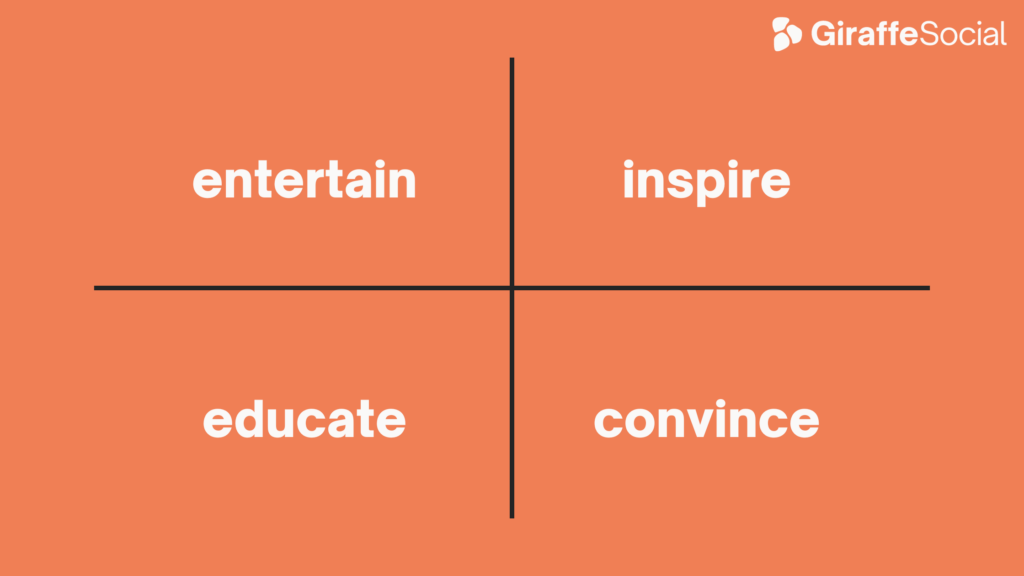
A content marketing matrix maps ideas by the response they are meant to create: entertain, inspire, educate or convince. It helps a team move beyond a calendar of disconnected posts and choose content that serves a specific person at a specific point in their decision.
The four-quadrant model was popularised by Smart Insights. Use it as a planning prompt, not a quota for four equal piles. A bank explaining account security may need more education than entertainment; a hotel may use inspiration to open the conversation while still answering booking questions clearly.
What is the content marketing matrix used for?
Map what you already publish, then look for the questions and decisions it leaves unsupported. If every post promotes an offer, people still learning about the problem have little reason to pay attention. If every piece educates but never shows proof or a next step, a ready buyer may remain stuck.
Start with the audience and a real decision. A participatory format might entertain, a customer story could inspire, an explainer can educate, and a demonstration or honest comparison can convince. One asset may do more than one job, but giving it a primary purpose makes the brief and measurement clearer. Our social media strategy service starts with these audience and commercial questions.
1. Entertain
Entertaining content earns attention by giving people something enjoyable or interesting in its own right. A playful poll, a behind-the-scenes moment or a short demonstration can make a useful idea easier to notice and remember. The format should fit the audience and the brand; humour that distracts from a sensitive subject is a poor trade.
Give the interaction a purpose. A question about common customer frustrations can reveal what to explain next, while a creative demonstration can show the people behind the service. Look beyond views to whether the right audience responds, shares or moves on to a more substantial answer.
2. Inspire
Inspiration helps someone imagine a worthwhile change. Show the people, effort and context behind a result rather than relying on a sweeping promise. A guest story can reveal the care behind a hotel stay; a customer example can show how a team worked through a challenge. The detail makes the possibility believable.
Use interviews, considered creator work or a well-told case story. Get permission where people are identifiable, explain what actually happened and avoid implying that one outcome is guaranteed for everyone. The aim is to help a reader see what could be possible for them, then point to the information they need to judge fit.
3. Educate
Educational content answers a question well enough for someone to act with more confidence. Explain the steps, trade-offs and terminology in plain language. A useful how-to guide might show a customer what information they need before booking a service; a product explainer might clarify what a feature can and cannot do.
Start with questions people actually ask in search, sales conversations and support tickets. Include examples, current evidence and a clear date for information that changes. Link to the original source when quoting research or guidance. Measure whether readers find the answer and what they still ask afterwards, not simply the number of words published.
4. Convince
Convincing content helps a person decide whether an offer is right for them. It provides proof and removes uncertainty: a demonstration shows the experience, a case study explains the starting point and result, and a comparison makes differences clear. Include limits, costs or requirements that matter to the decision rather than hiding them behind a call to action.
This quadrant often serves someone already weighing options, but it need not be aggressive. A precise answer from a practitioner can be more persuasive than a louder sales claim. Measure the quality of enquiries, bookings or purchases alongside the questions that remain unanswered.
How to build and use a content marketing matrix
Begin with a specific audience and decision. What question are they trying to answer, and what should they be able to do after seeing the content? A first-time prospect and an existing customer may need very different explanations.
Next, choose the primary job of each idea: entertain, inspire, educate or persuade. Put it in the quadrant that best describes the response you want. A piece may serve more than one purpose, but giving it one main job makes the brief clearer. Our content strategy guide covers the wider planning process.
Match the idea to the decision stage
The matrix and the buying journey answer different questions. The matrix describes the response a piece should create; the journey tells you when and why a person needs it. Early content might introduce a problem or make the brand memorable. Someone comparing options may need an explanation, demonstration or case study. A person ready to enquire may need fees, process and proof.
Do not assume every audience moves through a neat funnel. Some arrive already informed; others return with new questions. Use the matrix to spot missing types of content, then check those ideas against real customer behaviour.

Audit what you already have
Place existing articles, videos, emails and social posts on the matrix. Tag each with its audience and the question it answers. You may find plenty of awareness posts but little evidence for someone comparing options, or several similar explanations of the same topic. Fix the gap before commissioning more content.
Choose the next ideas
Use the empty spaces as prompts, not quotas. Ask whether a useful answer already exists and whether the proposed format suits the subject. A customer question may be better answered by updating a product page than by making another social post.
Check what others cover
Competitor content can reveal common questions and overused angles. Compare the substance, not just the format, and identify where your own experience or evidence can provide a clearer answer. Our competitor analysis guide explains how to do that without copying.
A worked example: a B2B software launch
Imagine a company selling a scheduling tool to operations teams. An educational article explains why handovers fail. A short video shows a team using a clearer process. A customer story makes the operational change tangible, while a product demonstration helps a buyer judge fit. Each piece has a different job, yet all serve the same decision.
The next step should match the question. Someone reading the educational article may want a practical checklist; someone reviewing the customer story may need the full case details; a buyer watching the demonstration may be ready to ask about implementation. The matrix keeps these pieces connected without repeating the same sales pitch.

Review the response, then adjust the plan
Judge each piece by the response it was designed to create. An educational article might be measured by useful visits and the questions it resolves. A demonstration may lead to qualified enquiries. Reach and likes show exposure, but they cannot establish whether the content helped someone decide.
Review the matrix with sales, customer support and delivery colleagues each quarter. Ask which questions still need manual answers, which claims lack proof and where people stop moving forward. Update the content that already exists before adding another format. A content calendar can then schedule the work; it serves a different purpose from the matrix.
If you need help connecting the plan to channels and production, read our social media marketing guide.
Editor’s note — 18 September 2026: The four quadrants were corrected and rewritten, with practical examples and a clearer way to use the matrix. This article was originally published in October 2019 and updated in October 2022 and November 2023.