

Scroll through most B2B LinkedIn feeds and you’ll spot the same pattern within thirty seconds: a wall of product announcements, the odd “we’re hiring” post, and a case study every few weeks dressed up as a “success story.”
It’s not that this content is badly written, it’s that the content formula behind it is wrong.
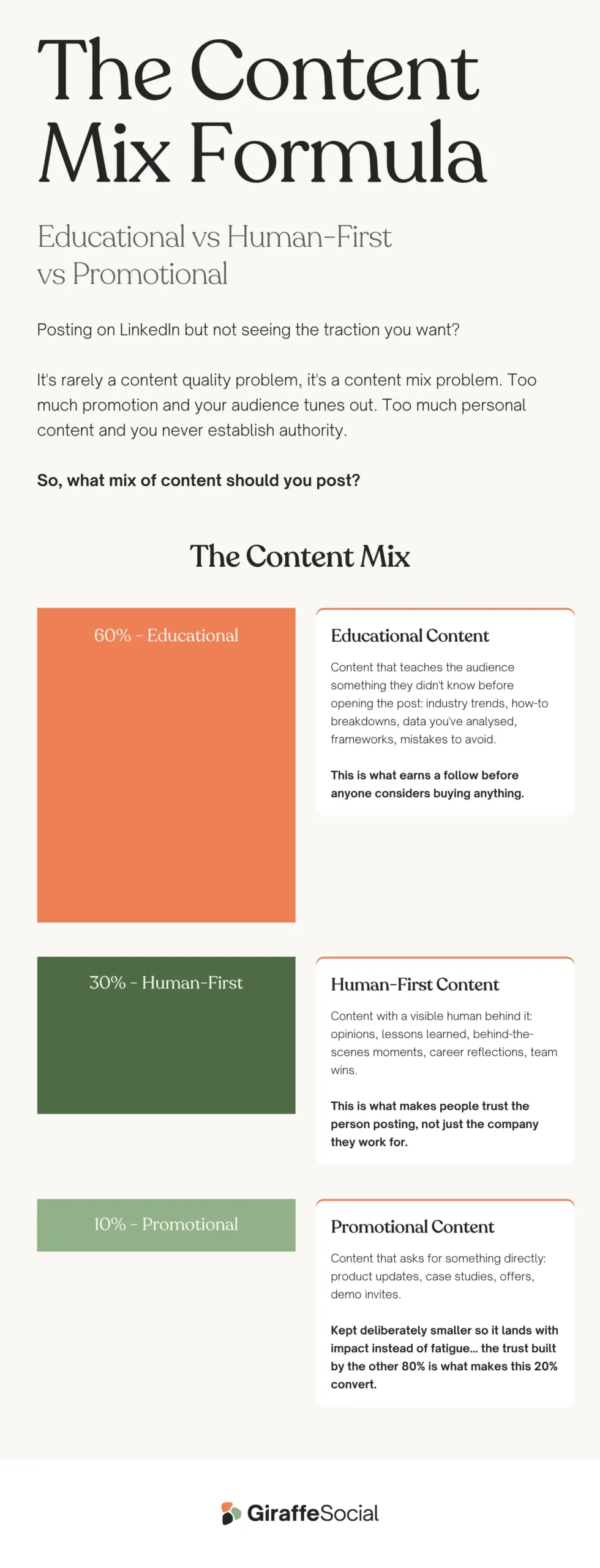
Here’s the pattern that actually works, and it’s simpler than most content calendars make it look:
- 60% educational content
- 30% human-first content
- 10% promotional content
Get that ratio right and the platform starts working for you instead of against you. Get it backwards (heavy on promotion, light on everything else) and you can end up shouting into a feed that’s already tuned you out.
Trust us, as a B2B social media agency that has been working with clients all over the world for decades, this formula is the best place to start.
Why “promotional” is the smallest slice, not the biggest
Most brand pages get this backwards because promotion feels like the point. You’re on LinkedIn to generate leads, so surely the majority of your content should be about your product. It’s an understandable instinct, and it’s the single biggest reason B2B pages plateau at a few hundred followers who barely engage.
Promotional content only converts once trust already exists. Nobody comments on a product announcement from a company they’ve never heard talk about anything else. The 10% isn’t a compromise, rather it’s a multiplier. When you’re posting a minimal amount of promotional content, each post works precisely because it’s rare, and because the 90% of other content around it has already done the work of making people want to hear about the other 10%.
Think about the accounts you actually stop scrolling for. It’s rarely the ones posting “excited to announce” updates every week. It’s the ones who taught you something useful three posts ago, or said something that made you nod along, and who you now trust enough to actually read when they do have something to sell.
Educational Content: the credibility engine
The 60% dedicated to educational content is what does the heavy lifting for authority. This is industry insight, how-to breakdowns, data you’ve pulled together yourself, frameworks, mistakes you’ve seen (or made) and what you’d do differently.
The test for whether something qualifies as educational is simple: does the reader walk away knowing something they didn’t five minutes ago?
This is also the content that performs best with LinkedIn’s own distribution logic. Posts that get people reading to the end, commenting with a real opinion, and saving for later get shown to more people. A well-argued insight post does that far more reliably than a product graphic ever will, because there’s actually something to respond to.
The mistake most teams make here is playing it too safe. “5 tips for better project management” teaches nobody anything they couldn’t get from the first page of a Google search. The educational content that actually builds a following has a point of view in it. Neutral advice is forgettable, but content with a clear position invites a reply.
Human-First Content: the trust you can’t fake with a logo
The 30% for personal content is the piece most B2B brands under-invest in, and it’s usually the highest-engagement category on the page once teams actually try it. This is where the human behind the company shows up: a genuine opinion, a lesson learned the hard way, a behind-the-scenes look at how a decision actually got made, a team win worth celebrating out loud.
People build trust with people, not with logos. A founder’s honest take on a mistake the company made last quarter will outperform a polished brand statement almost every time, because it reads as something a real person actually believes rather than something a brand account was told to post. That authenticity is exactly what makes the eventual promotional post land instead of getting scrolled past.
If your page has been all-business so far, this is the category to start with. It requires the least production effort and tends to produce the fastest engagement lift, because it’s the content type most competitors are still avoiding.
The Infographic
Check out the full infographic below, with all of the above summed up into a handy, easy to understand format you can keep coming back to!