

Your customers are already telling you everything you need to know about your brand. Social listening is how you hear it. And the brands that aren’t listening are losing customers to the ones that are.
Constant conversations are happening about your brand, your industry, and your competitors. They happen in comment sections, on review platforms, and in places you might not even think to look. Some of it will be positive. Some of it will be a warning sign. But it’s all useful if you know what to do with it.
In this guide, we’ll show you how to go from tracking conversations to actually doing something useful with them.
Social Listening vs. Social Monitoring
Most marketers think they’re doing social listening, but they are just social monitoring.
Social monitoring is reactive. It tracks direct mentions, tags, and notifications, which is useful for managing responses, but it only shows you what’s already been flagged. Social listening goes deeper. It looks at patterns, sentiment, and themes across conversations, including the ones where no one has tagged you. This difference is asking “what are people saying?” and “what does it mean, and what should we do about it?”
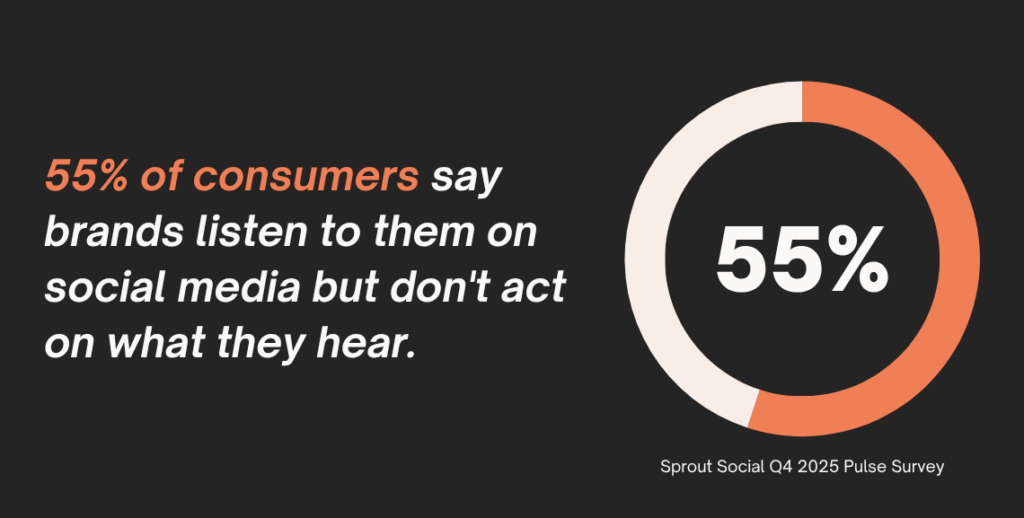
According to Sprout Social, only 31% of companies both listen to and act on social conversations. The other 69% are either not listening at all, or are gathering insights that they never do anything with. Using what’s being said about your brand as a guide for your next strategic steps starts with knowing what to track.
What You Should Track and Why
Without an understanding of what to track, social listening can quickly become overwhelming. There’s so much going on, on so many platforms, that the amount of information you can pull feels almost endless. But you don’t need to track everything. Here’s what you should be monitoring.
Brand Mentions – Tagged and Untagged
Most brands only track the mentions where someone has directly tagged them. But untagged mentions are where the most honest opinions can be found. These are the conversations people are having without any expectation that you’re watching, which is exactly what makes them valuable.
Customers venting about a bad experience without tagging your brand, or recommending your product to their network organically, are conversations you should know about. If you’re only tracking tags, you’re missing the majority of what people are actually saying about you.
Competitor Activity and Share of Voice
Understanding how much of the conversation is owned by your competitor allows you to spot gaps in how your business is positioned. If another brand is dominating the discussion around a topic that’s core to what you do, that’s something you need to know about and act on.
Tracking competitor sentiment also tells you where they’re not doing so well, and where there’s an opening for you to take over the conversation. Understanding your share-of-voice relative to competitors is one of the most powerful benchmarks available.
Sentiment Shifts
A single negative mention isn’t necessarily an immediate cause for concern. However, a sudden dip in positive sentiment across hundreds of conversations might be.
The point of sentiment tracking is to spot patterns in how your brand is being mentioned. Are people talking about your brand more positively or negatively than they were a few months ago? Did a recent campaign cause a change in this? Did a product issue spark discussions that you weren’t aware of? Tracking sentiment is about trends that give you early warning signs of when customer opinion is changing.
Industry Keywords, Trending Topics and Customer Pain Points
Tracking the broader conversation in your industry helps you understand what your audience cares about. Trends move fast on social media, and joining conversations early will help get you noticed. Tools like Google Trends can help you identify which topics and search terms are gaining momentum, allowing you to join in whilst it’s still relevant.
But it’s not just about trends. The language people use when they’re frustrated or confused is also incredibly valuable information for your business. If the same question keeps coming up across platforms, this is probably something that needs addressing. Perhaps the same complaint keeps surfacing. That signals there might be a product or process issue that needs investigating. Monitoring industry keywords, alongside customer pain points, gives you both the big picture and the intricate details, which is where some of the most valuable insights come from.
Tools of the Trade
The social listening market is projected to grow from $8.44 billion in 2024 to $16.19 billion by 2029. That growth signals that brands are finding social listening to be both a relevant and valuable element of their campaigns. No matter your budget, there’s a tool that can help you also include social listening as part of your strategy.
Enterprise
Large organisations often want to invest in the best-of-the-best when it comes to tools for social listening. Brandwatch and Sprinklr are the two most established you can pick from.
Both offer comprehensive coverage across platforms, AI-powered sentiment analysis, and customisable dashboards, useful for understanding and presenting data to stakeholders. Although they come with a pretty high price tag, the depth of data and analysis they can offer makes them a tool of choice for brands monitoring high volumes of conversation or operating across multiple markets.
Mid-Market
Hootsuite, Sprout Social, and Mention sit in the sweet spot between capability and cost.
Hootsuite is best known as a scheduling and management platform, but it also includes social listening as part of its toolkit. Brands that choose this tool find it particularly useful if they want everything in one place.
Sprout Social is similar to Hootsuite, but goes deeper on the listening and analytics side, including sentiment analysis and reporting tools. It’s a good option for brands that need to present their insights to clients or stakeholders, as this can all be done from within the platform.
Mention is solely used for monitoring and listening. Brands that don’t need the broader platform features that the others offer love this tool, as it’s specifically dedicated to tracking conversations.
Free Options
If you’re just getting started with social listening, or your brand has a limited budget, there are some great free tools you could use.
Google Alerts and the native analytics built into platforms like Instagram, LinkedIn, and TikTok are a good place to start your exploration into social listening. With Google Alerts, you can set up notifications for your brand name, competitor names, and key industry terms. Relevant mentions then get sent directly to your inbox without having to go looking for them.
You won’t get the cross-platform sentiment analysis or share-of-voice data that you would with other tools, but they’re a great, free way to start building social listening habits before committing to a paid tool.
Turning Insights into Action
So, you’ve gathered the data, now what? The real value of social listening comes from what you do with it. You need to turn what you’re hearing into decisions that guide your business growth decisions.
Product & Content Development
Social listening data can be really valuable when used to feed your content and product strategies. The information you collect around what questions your customers are asking, what frustrations they express and what they rave about should be used to build the brief for your next piece of content or product iteration.
Vaseline is a good example of this in practice. In 2025, TikTok creators began sharing “Vaseline hacks”, showing how the product could be used for everything, from improving perfume longevity to restoring shoes. The videos were generating millions of views. Rather than ignoring the trend or trying to control it, Unilever (Vaseline’s parent company) used social listening to identify the surge in conversation, had its scientific teams verify the most popular hacks, and then collaborated with creators to produce content confirming which uses actually worked. The result was a campaign that felt authentic because it joined in the conversations their audience was already naturally having.
Crisis Detection
If a crisis reaches the news, it’s already too late. But social listening allows you to get early warning signals before it escalates that far. It will show you sudden spikes in negative mentions, a shift in sentiment, and if a specific complaint is gaining traction.
You can set up alerts to notify you when conversation volume or sentiment around your brand changes significantly, rather than finding out when someone sends you a link to a critical article. That way, you can get ahead of it and either correct the issue or prepare a response to what is coming.
Competitor Intelligence
Social listening doesn’t have to just be used to find out what people are saying about your brand. You can also use it to find out what audiences are saying about your competitors. Tracking sentiment around other brands tells you where they’re succeeding, where they’re falling short, and where there’s a gap in the market you could fill.
Samsung’s response to Apple’s “Crush!” ad in 2024 is a great example. When Apple released an iPad Pro ad showing creative tools being destroyed by a hydraulic press, the creative community responded in outrage. Samsung were using social listening to monitor Apple, and responded to this huge shift in sentiment quickly. They released a counter-ad called “UnCrush” within days, featuring a musician salvaging a battered guitar from the wreckage, with the message “Creativity cannot be crushed.” It was a well-timed, well-executed response that worked because Samsung was listening to what a competitor’s audience was saying.
Campaign Optimisation
Using social listening, you can get a sense of how a campaign is being received in real time and make adjustments while it’s still running. If a particular message is resonating, you can double down on it. If the sentiment around a particular creative is shifting in the wrong direction, you can redirect it.
Turning that social data into actionable strategies is where the competitive advantage lies. The sooner you act on what the data is telling you, the more useful it becomes, and the less likely you are to find yourself dealing with poor results.

Conclusion
Social listening is an ongoing practice that gives you a clearer picture of your market than almost anything else. You should treat online conversations as data, using them to spot opportunities, respond to problems faster, and build strategies around what your audience actually thinks.
Whether you’re just getting started with Google Alerts or you’re ready to invest in a more expensive tool, the most important thing is to start. Your customers are already telling you what they need. The question is whether you’re listening.